Opinion: What Russia could learn from the Doukhobors
More than 130 years ago, Doukhobors under Russian rule burned their weapons rather than fight. Their history still asks a difficult question: when does conscience outweigh obedience to the state?
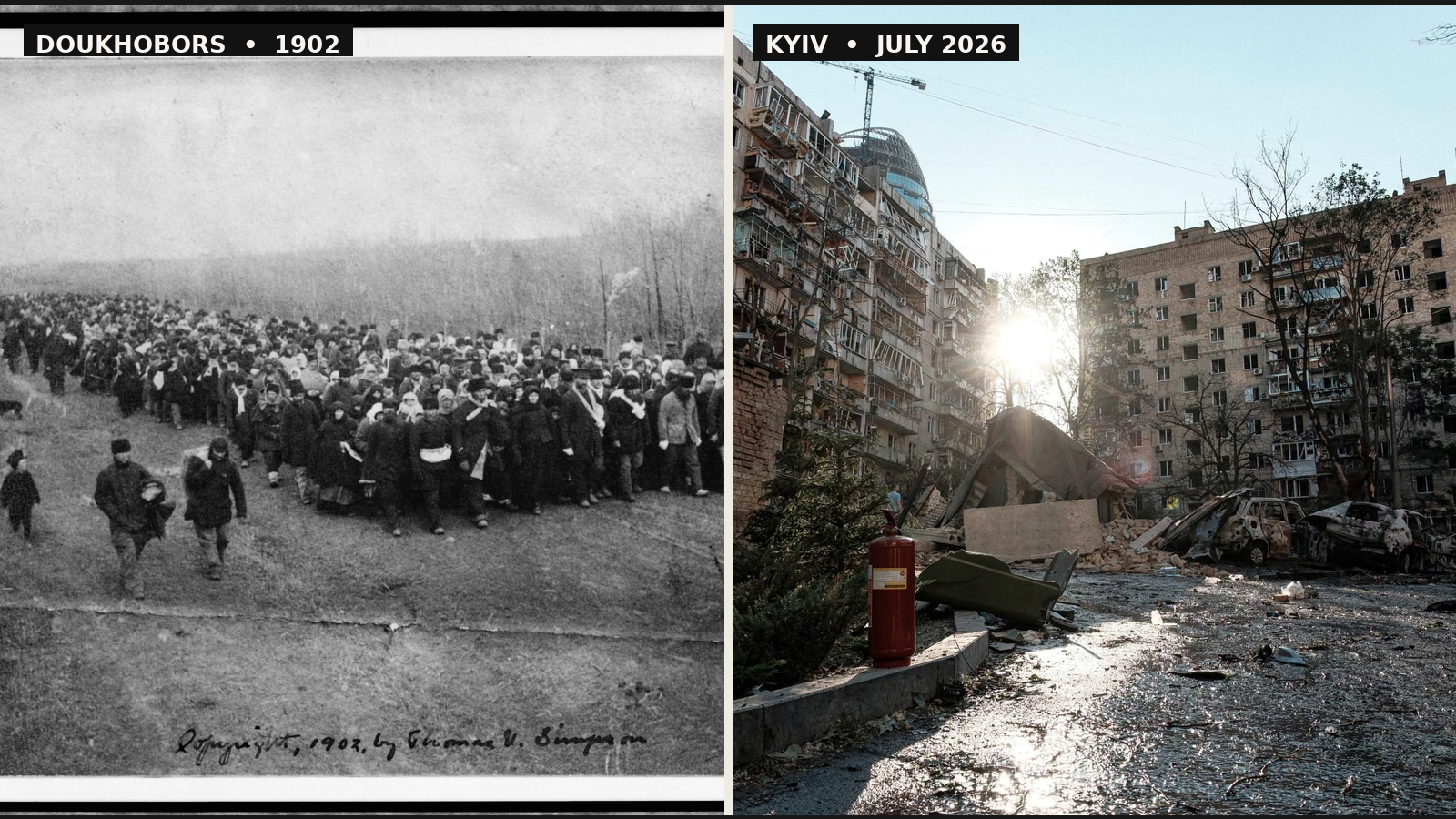
Doukhobor pilgrims near Yorkton, Sask., in 1902, left, and damage in Kyiv following a Russian attack in July 2026. More than a century after Doukhobors rejected military service under the Russian Empire, their history raises difficult questions about obedience, conscience and Russia’s war in Ukraine.
Photos: Library of Congress/public domain;
State Emergency Service of Ukraine/CC BY 4.0
As I read the news from Kyiv this week, I find myself thinking back 131 years to a very different Russia, and to a group of people whose story is particularly familiar here in the Boundary.
Overnight Wednesday into Thursday, Russian missiles and drones struck Kyiv and the surrounding region in an attack that lasted nearly nine hours. Seventeen people were killed and more than 40 were injured. The upper floors of a nine-storey apartment building were destroyed. A school, kindergarten and children's hospital were among dozens of buildings damaged. Outside one apartment block, Reuters described an elderly woman sobbing as rescuers brought out the body of her grandson.
For Ukrainians, it was one terrible night in a war that had begun earlier. Russia seized Crimea in 2014, and fighting in the Donbas followed, beginning eight years in which war was already part of Ukrainian life before Russia launched its full-scale invasion. The invasion widened that war dramatically, but it did not reset the clock.
Nor is the danger receding as the war drags on. United Nations human rights monitors recorded at least 437 civilians killed and another 2,610 injured in Ukraine in July alone, the highest monthly number of civilian casualties they had documented since March 2022. Long-range missiles and drones increasingly account for deaths far from the front lines, including in cities where people are trying to maintain something resembling ordinary life. Kyiv was one of the hardest-hit cities in July, with at least 54 civilians killed and 202 injured during the month.
It is easy from this distance to discuss Ukraine through the language of geopolitics: territory, security guarantees, negotiations and competing visions of how the war might end. Those questions are important, but they can obscure what is being fought over.
Most people want remarkably ordinary things from life. They want to go to work and expect to come home. They want to raise their children, plant a garden or make plans for next year without wondering whether their city will be bombed overnight. They want some say over their government and some confidence that another country cannot simply redraw their future by force.
That very ordinary desire is what sends my thoughts back to the Doukhobors.
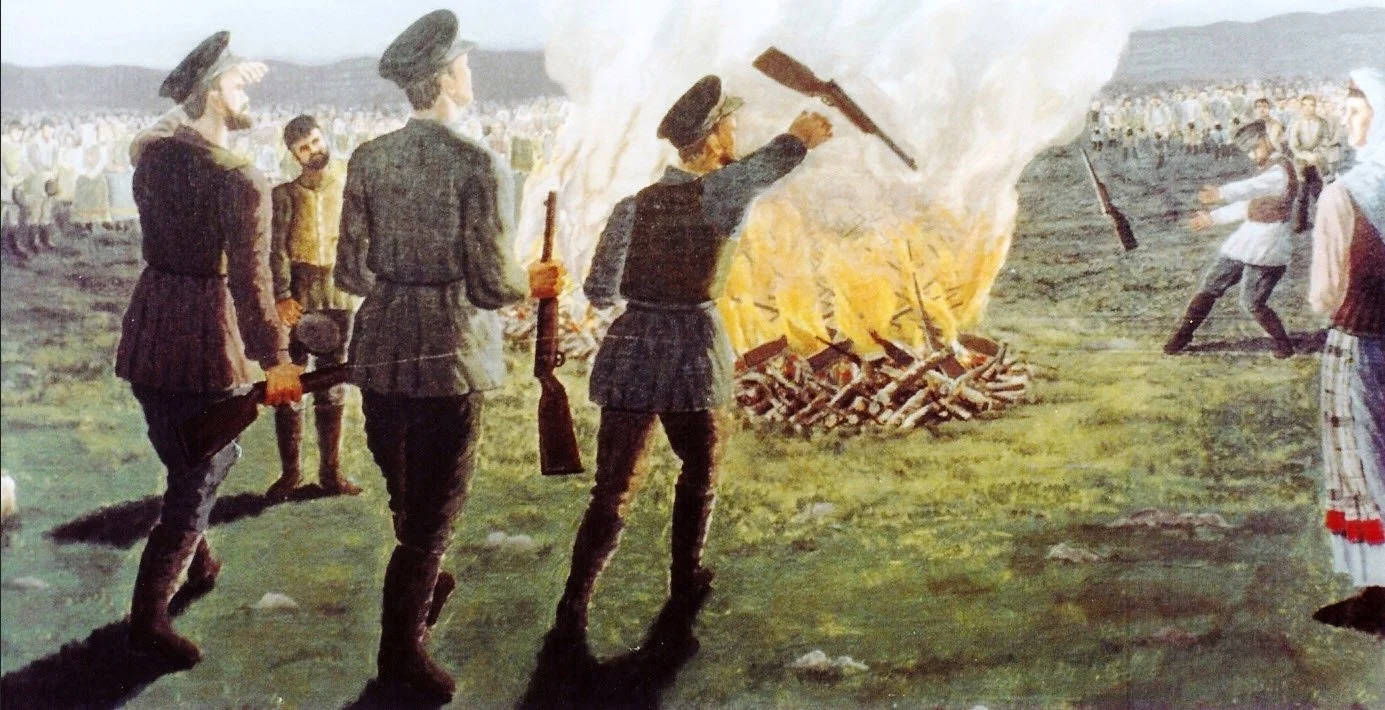
The Burning of Arms, painted by Michael M. Voykin (Castlegar) in 1974.
In 1895, Doukhobors living under the Russian Empire were confronting their own question about war and obedience. Their leader, Peter V. Verigin, had called on his followers to reject violence and military service. That summer, Doukhobors in the Caucasus collected the weapons in their possession, piled them together and burned them while singing psalms. Men already serving in the military refused further service. The Burning of Arms was both symbolic and practical: they were declaring that the state could no longer count on them to participate in killing.
The Russian authorities responded brutally. Doukhobors were beaten and imprisoned. Some were sent into exile or penal battalions, and entire communities suffered persecution in the years that followed. Eventually thousands left Russia for Canada beginning in 1899, looking for somewhere they might live according to their own beliefs. Canada was hardly the uncomplicated refuge that popular histories sometimes make it sound like, and the Doukhobors would have serious conflicts with governments here as well. Still, their migration allowed them to begin building communities around principles that included pacifism, communal work and the ideal later expressed in the phrase “Toil and Peaceful Life.”
Some eventually made their way to British Columbia and became part of the history of this region. In Grand Forks, that history remains unusually tangible. The Boundary Museum occupies the former Fructova School, built by Doukhobors in 1929. Farms, industrial sites, family histories and other traces of Doukhobor settlement remain woven through the Boundary and neighbouring Kootenays. The Burning of Arms is therefore more than an episode in a Russian history book for locals. It’s part of the chain of events that eventually brought thousands of people across an ocean and, for many, into this corner of British Columbia.
“Toil and Peaceful Life” belongs to the Doukhobor tradition, and I would not presume to place those words in the mouths of Ukrainians. Yet the longing behind them is hardly unique to one religious community. There is something deeply human in wanting to work, raise a family and build a home while being left free to determine the course of your own life. Ukrainians have spent four and a half years trying to preserve that possibility against an invading army. The Doukhobors, in another time and under very different circumstances, concluded that their own conscience would no longer permit them to become part of an army taking that possibility from somebody else.
That is where the history becomes uncomfortable for Russia today.
I don’t want to pretend that an ordinary Russian can simply refuse and walk away. People have been jailed for opposing this war, and others have left Russia because staying became impossible. Refusal carries a real cost. The Doukhobors knew that too. They were beaten, imprisoned and exiled, and thousands eventually left Russia altogether. Yet they still reached a point where the consequences of refusing seemed preferable to taking part in something they believed was wrong.
The Doukhobors confronted that relationship between the individual and the state more than a century ago. The Russian government could demand military service and punish those who refused it. What it could not do was remove the individual's responsibility to decide whether obeying that command was morally acceptable. Their answer was costly. They did not burn their weapons because resistance was safe or because they knew everything would work out in the end. They acted knowing that the Russian state had considerable power to make them suffer for it.
That matters when considering Russians today, because refusing the current Russian state is dangerous too. Russia has spent years suppressing opposition to the war and criminalizing criticism of its armed forces. Human Rights Watch reported that at least 1,299 people had faced criminal prosecution for opposing the war by the end of September 2025, with hundreds imprisoned. This week, Russian opposition politician Lev Shlosberg was sentenced to more than 11 years in a penal colony after repeatedly criticizing the war and calling for a ceasefire.
It would therefore be glib for someone sitting safely in Canada to suggest that Russians need only say no. I cannot know what I would do if protest could cost me my freedom, or if refusing military service could mean prison, persecution or having to leave my country. There are Russians who have made precisely those choices. Some have protested, some have fled and some have accepted prison rather than publicly support a war they believe is wrong. Their existence also makes it impossible to talk about “the Russians” as though more than 140 million people share a single conscience.
But fear does not make the underlying question disappear. The Doukhobors were frightened people living under an authoritarian empire too. They had families to protect and homes they did not want to abandon. They understood that the state could inflict serious punishment, and history shows that it did. What their example demonstrates is that even a powerful state ultimately encounters a boundary it cannot cross on its own: at some point it needs individuals to carry out what it has decided to do.
As Russian weapons continue to fall on Ukrainian cities, I keep returning to the choice made around those fires in 1895. The Doukhobors could not stop the Russian Empire from maintaining an army or waging wars, but they could decide that they would not be the ones carrying out violence they believed was wrong. That matters because even the most authoritarian government eventually depends on ordinary people to turn policy into action.
More than 130 years ago, the Doukhobors decided that the Russian state could punish them for refusing military service, but it could not decide the limits of their conscience. Many paid dearly for that decision. Thousands eventually left Russia, and some of them found their way here, where the evidence of the lives they rebuilt is still part of the Boundary.
The Doukhobors could not end Russia’s wars, but they could refuse to take part in them. What might happen now if enough Russians made that same choice, and those individual refusals became something the state could no longer ignore?





The discussion around the recent wildfire-related off-road vehicle restrictions got me thinking about more than one temporary ban. It also brought out a lot of strong opinions about e-bikes, trail users and who belongs on our local trails.