Province announces completion of Grand Forks flood-mitigation program
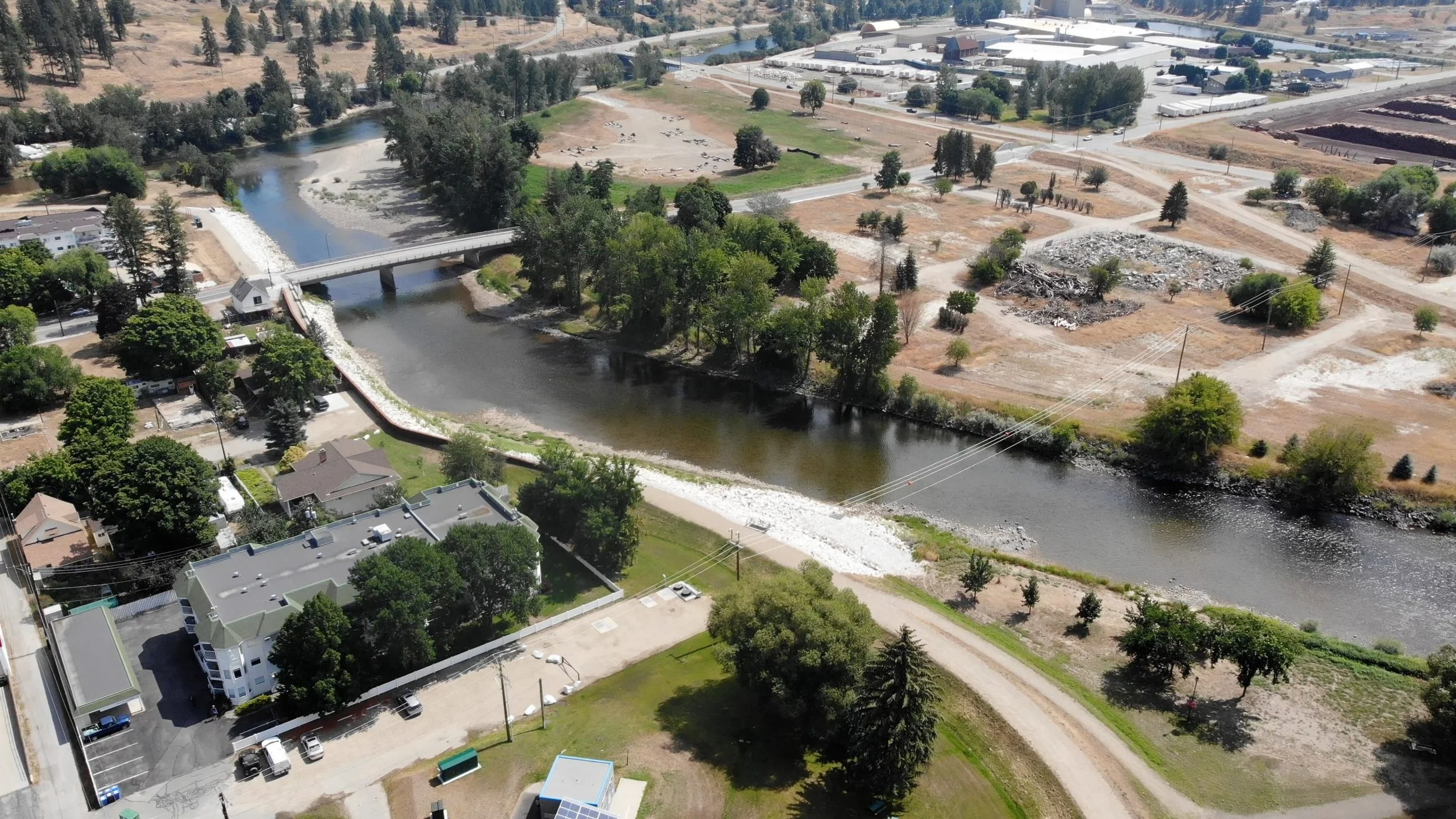
Completed flood-mitigation works along the Kettle River in Grand Forks, with City Park in the foreground and the North Ruckle dike and restored floodplain in the background.
— Photo, Government of British Columbia
Four new dikes, drainage systems and restored floodplain provide protection for more than 300 residential, commercial and industrial properties
GRAND FORKS — The provincial government announced July 17 that the Grand Forks Flood Mitigation Program, developed following the destructive 2018 flood, has been completed.
The projects provide flood protection for 117 hectares of residential neighbourhoods, commercial areas, industrial land and critical infrastructure. The protected area includes more than 200 residential properties and 108 commercial and industrial properties, including most of downtown and the city’s main industrial area.
More than 400 residents and an estimated 875 jobs are located within the protected area, according to the Province.
The program includes four new dikes totalling more than three kilometres, 390 metres of stormwater mains and two permanent stormwater pumping stations capable of removing 3,040 litres of water per second.
More than 500 metres of additional drainage and stormwater improvements were also completed.
“In the wake of the devastating 2018 flood, we made a commitment to rebuild stronger and reduce the risks posed by future flood events,” Grand Forks Mayor Everett Baker said in a statement.
“Today, our neighbourhoods, businesses, industries and critical infrastructure are better protected because of that commitment and the strong partnership between the city, the Province, the federal government and our community.”
Program followed record 2018 flooding
The mitigation program was developed after the Kettle and Granby rivers flooded Grand Forks on May 10, 2018.
The flood, described by the Province as the worst in the city’s recorded history, followed a week of high temperatures and three days of rain. Rapid melting of a snowpack almost two and a half times the early-May average contributed to rising water levels.
During the recovery period, the city worked with the Province and the Regional District of Kootenay Boundary to develop a system combining dikes, drainage infrastructure and natural flood-management measures.
One of the largest parts of the program involved restoring approximately 10 hectares of floodplain between the new downtown dikes and areas south of the Kettle River.
The work included purchasing and removing the 66-home North Ruckle neighbourhood, which was heavily affected by the flood. Houses, foundations, roads, utilities and a dike built in 1974 were removed to create more space for the river during high-water events.
The older dike was overtopped and breached in 2018.
The program involved the acquisition of 70 residential properties and 20 vacant properties. More than 20 statutory rights of way were also secured on provincial and private land to support the construction of dikes and drainage systems.
Nineteen homes were relocated to new properties.
Habitat channel created
The program also included the creation of a 1.8-hectare off-river bypass channel designed to reduce flood risk while providing fish habitat.
Fish-habitat structures were installed in the channel, and approximately 28,000 trees and shrubs were planted along its banks and in nearby areas.
“People in Grand Forks and their neighbourhoods are much safer with the completion of these projects, which are the result of good collaboration between the city, the Province and the federal government,” said Kelly Greene, B.C.’s minister of emergency management and climate readiness.
Greene said the program demonstrated what could be accomplished when municipal, provincial and federal governments work together to reduce risks associated with a changing climate.
Governments contributed millions
The City of Grand Forks contributed approximately $9 million toward the mitigation program.
The federal government provided nearly $20 million through the Disaster Mitigation and Adaptation Fund.
The Province initially contributed nearly $29 million, followed by another $2.6 million for protective work in the downtown area.
Four grants worth more than $8 million were later provided through the Community Emergency Preparedness Fund. The Regional District of Kootenay Boundary received an additional $815,000 through the fund for related work.
The Province said it has provided approximately $60 million for flood response, recovery and mitigation in Grand Forks and the surrounding Boundary region since 2018.
That total includes approximately $19 million in initial response and recovery assistance, including support for people displaced by the flood.
Stephen Fuhr, MP for Kelowna and secretary of state for defence procurement, said disaster-mitigation measures have become increasingly important as communities face climate change and extreme-weather events.
Baker said completing the program should provide residents and businesses with greater confidence while strengthening the city’s ability to withstand future floods.

Grizzly Discoveries Inc. is seeking to raise up to $2 million as the company continues fall exploration across its Greenwood-area properties and prepares for drilling planned between October and December.