Nelson hosts international ion-source conference as local research capacity grows
More than 100 scientists, engineers and researchers from about 20 countries are gathering in Nelson for work with applications ranging from medical imaging and cancer treatment to semiconductors and fusion energy.
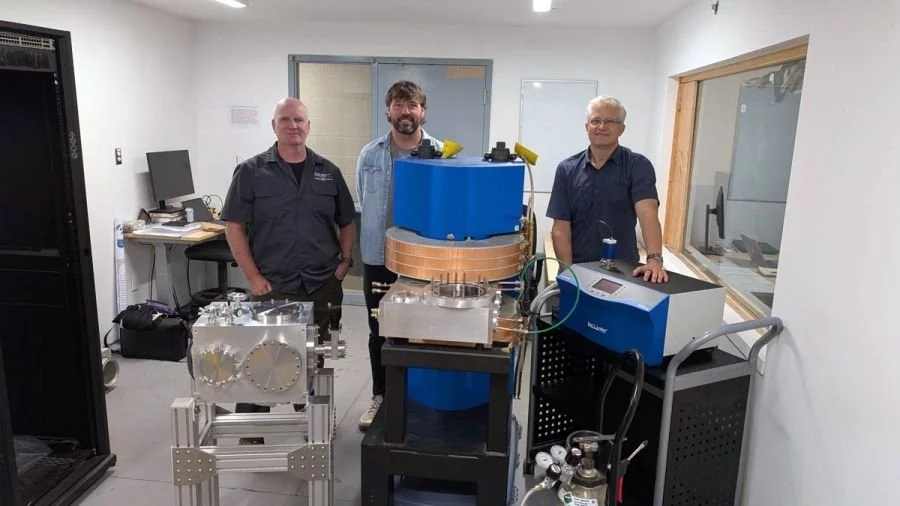
From left, Jason Taylor of the Selkirk Technology Access Centre, SIRC researcher Ben Warfield and SIRC chair Morgan Dehnel with ion-source equipment.
Photo courtesy Selkirk College.
NELSON — A specialized field of particle-accelerator science is bringing researchers from around the world to Nelson this week, where a local company and a new Selkirk College research centre have been building expertise in ion-source technology.
The 10th International Symposium on Negative Ions, Beams and Sources runs Sept. 20 to 25 in Nelson, with oral sessions and the conference dinner at the Prestige Lakeside Resort and other events, including poster sessions, at the Hume Hotel. Selkirk College says more than 100 scientists, researchers, engineers and innovators from about 20 countries are attending.
The symposium has been held every two years since 2008 and focuses on the production and use of negative ions — atoms that carry an additional electron — and the particle beams produced from them. The technology is used in research, industrial processes and medical applications, including medical cyclotrons, semiconductor manufacturing and fusion-energy systems.
This year's conference is being hosted by the Selkirk Ion-source Research Centre, or SIRC, with Nelson-based D-Pace and TRIUMF, Canada's national particle accelerator centre.
The partnership places the meeting in a region where ion-source technology is already being researched, manufactured and tested. D-Pace designs ion sources, beamlines and diagnostic equipment for particle accelerators and operates a research, manufacturing and testing facility in Nelson.
Founded in 1995, the company now has more than 25 employees in Nelson and Vancouver. Its Nelson operation includes a purpose-built facility of more than 500 square metres where accelerator equipment can be designed, manufactured, integrated and tested.
D-Pace's products include negative-ion sources based on technology licensed from TRIUMF, along with systems used in medical, industrial and research accelerators. The company also operates ion-source test stands in Nelson where equipment and new designs can be tested.
Its relationship with Selkirk College predates the new research centre. D-Pace opened a manufacturing and testing facility at the college's Silver King campus in 2018 and has provided experiential learning opportunities for trades students.
That relationship expanded in 2025 when Selkirk established SIRC with equipment donated by D-Pace. Selkirk valued the contribution at nearly $1 million and said it would support research, education and its partnership with TRIUMF.
SIRC is developing several ion-source test stands while connecting Selkirk students and researchers with institutions including TRIUMF, the University of Victoria and the University of Saskatchewan. Selkirk says the centre brings together trades apprentices, undergraduate and graduate students, postdoctoral researchers and other specialists to work on experiments that require both technical and research expertise.
Several SIRC researchers are taking part in this week's symposium. One project involves negative-hydrogen ion sources used in medical cyclotrons, where accelerated particles strike targets to produce radioisotopes used to make radiopharmaceuticals for medical diagnostics and therapy.
The current research builds on earlier D-Pace and Siemens work that reported a 20 per cent increase in extracted ion output while reducing arc power by 30 per cent. SIRC researchers are now testing other aspects of the system, including beam output, power use, cathode lifetime and safety.
Other Selkirk-linked work includes using optical emission spectroscopy and machine learning to estimate conditions inside an ion-source plasma, along with research into ion implantation for semiconductor manufacturing.
Selkirk says its semiconductor research could contribute to more efficient manufacturing of components used in electric vehicles, solar and wind systems and electrical infrastructure. The centre also identifies improved production of medical radioisotopes used in cancer treatment as one of its research priorities.
The conference program includes research involving accelerator systems at facilities such as CERN, medical isotope production, semiconductor processing, accelerator mass spectrometry and carbon dating, along with negative-ion beams being developed for fusion-energy systems.
Friday's program includes a presentation by SIRC research chair and symposium chair Morgan Dehnel surveying applications of negative-ion technology in national laboratories, fusion research, medical imaging and therapy, semiconductor manufacturing, accelerator mass spectrometry and carbon dating.
Dehnel has longstanding connections to both the local industry and Canada's national accelerator program. He earned his doctorate in accelerator physics through TRIUMF and UBC and founded D-Pace in 1995 before taking on his role as Selkirk's ion-source research chair.
The region's research capacity has also attracted new public investment. In March, the federal government announced $1.65 million for Selkirk College's Technology Access Centre in Trail to expand advanced manufacturing services and develop additional particle-accelerator and ion-source research capacity.
Selkirk says another $1.65 million from D-Pace, TRIUMF, Mitacs, Columbia Basin Trust and other partners brings the broader expansion to $3.3 million.
SIRC ultimately plans to operate four ion-source test stands, although several still depend on future funding. Its current equipment includes a Penning ion-source test stand donated by D-Pace, with additional equipment and contributions from TRIUMF and the University of Victoria.
“Hosting the symposium here in the Kootenays is an opportunity to showcase the cutting-edge work happening” at SIRC and Selkirk's Technology Access Centre, Dehnel said in the college's conference announcement.
The symposium continues through Friday, Sept. 25.







Charges have been laid against a man in connection with a February 2025 collision at Highways 97 and 33 in Kelowna that killed a woman.