Grand Forks, Midway groundwater monitoring wells hit lowest historical class
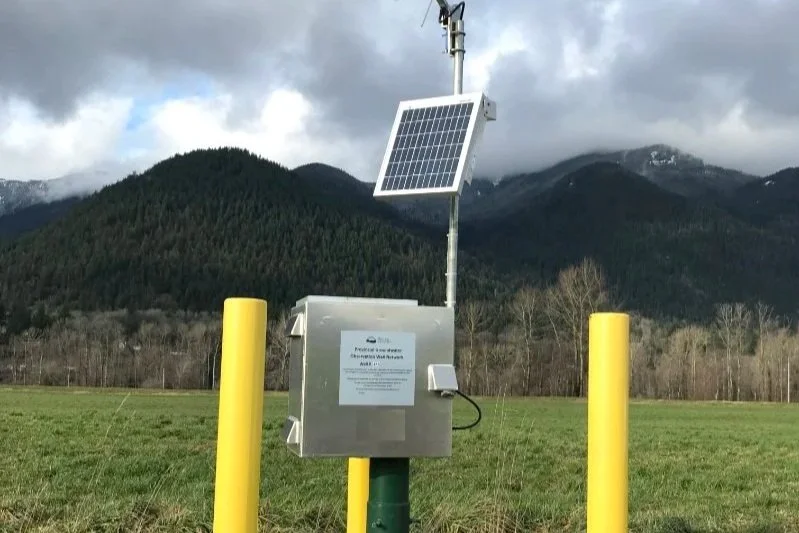
A provincial groundwater observation well equipped with a datalogger and telemetry equipment.
Photo: Province of B.C.
GRAND FORKS — Groundwater monitoring wells in Grand Forks and Midway have fallen into the lowest historical classification used by B.C.’s River Forecast Centre, according to provincial data through Sept. 19.
Both observation wells are classified as “Low (0%).” In the River Forecast Centre system, that means the groundwater level was the lowest measured for that day of the year within the continuous daily record used for comparison.
For the Grand Forks well, that comparison includes 22 years of continuous daily data. The Midway well has eight years.
The classification does not mean groundwater has reached its lowest level ever measured at either location. The province calculates percentiles separately for each day of the year, comparing the current reading with readings from the same point in the annual cycle.
Older monthly measurements are excluded from the percentile calculation, which uses only years with continuous daily records.
The Grand Forks observation well, OW217, is on Richmond Avenue and monitors an unconfined sand-and-gravel aquifer. The Midway well, OW444, also monitors an unconfined sand-and-gravel aquifer.
Both readings are listed as “Working” data, meaning they are preliminary and have not yet received final quality assurance.
Conditions elsewhere in the River Forecast Centre’s Kootenay-Boundary regional groundwater report are mixed.
Beaverdell’s observation well was at the 25th percentile on Sept. 19, putting it at the lower edge of the province’s Normal range. Jaffray was also classified Low, while wells near Golden and Cranbrook were Below Normal. Wasa and another Cranbrook-area well were in the Normal range.
The Grand Forks groundwater forecast indicates below-normal conditions could persist through the fall.
A River Forecast Centre forecast issued Sept. 20 gives the Grand Forks well a greater than 90 per cent probability of remaining below normal at both 14 and 30 days. The probability remains between 75 and 90 per cent at 60 and 90 days, extending into December.
The Midway observation well is not included in the current groundwater forecast.
The groundwater measurements add a new dimension to the drought conditions the Sentinel reported on in August.
Current River Forecast Centre data show the Kettle River near Westbridge at the 36th percentile for the date, the West Kettle River at Westbridge at the 49th percentile and the Granby River at Grand Forks at the 53rd percentile. All three fall within the 30th-to-75th-percentile range used in the River Forecast Centre’s streamflow report.
Despite those seasonal percentiles, all three seven-day averages remained below 10 per cent of their long-term mean annual discharge.
The Kettle River near Westbridge was averaging 2.41 cubic metres per second, or 8.57 per cent of mean annual discharge. The West Kettle was at 1.24 cubic metres per second, or 9.84 per cent, while the Granby was at 2.30 cubic metres per second, or 7.49 per cent.
The River Forecast Centre says flows below 10 per cent of mean annual discharge can reduce the amount and quality of riffle habitat available to fish.
The provincial groundwater readings do not establish the condition of municipal drinking-water wells or show that either community faces a water-supply shortage.
Midway continues to have a water-restriction notice in effect. Restrictions introduced Aug. 14 limit yard and garden watering to two hours per household per day between 6 and 10 a.m. and remain in place until further notice.
The village says its municipal water comes from deep wells that feed a reservoir and has also asked private well users to conserve water.
Grand Forks’ website currently gives conflicting information about watering restrictions. The city’s Utilities page lists Stage 1 restrictions, while its separate Sprinkling Regulations page lists the current stage as Normal.
The province issued a broader drought update Sept. 21 saying drought and water-scarcity conditions continue in parts of B.C. despite recent rainfall bringing local relief.
The Ministry of Water, Land and Resource Stewardship said some areas could remain affected through the winter and into 2027, and that depleted soils and groundwater can absorb precipitation before that water reaches rivers, lakes and reservoirs.



A specialized field of particle-accelerator science is bringing researchers from around the world to Nelson this week, where a local company and a new Selkirk College research centre have been building expertise in ion-source technology.