New weevil released in B.C. targets common tansy already established in the Boundary
Canada has approved its first biological-control agent for common tansy after years of testing. Whether any of the initial releases occurred in the Boundary, or whether the region will receive the insect in future, has not been publicly confirmed.
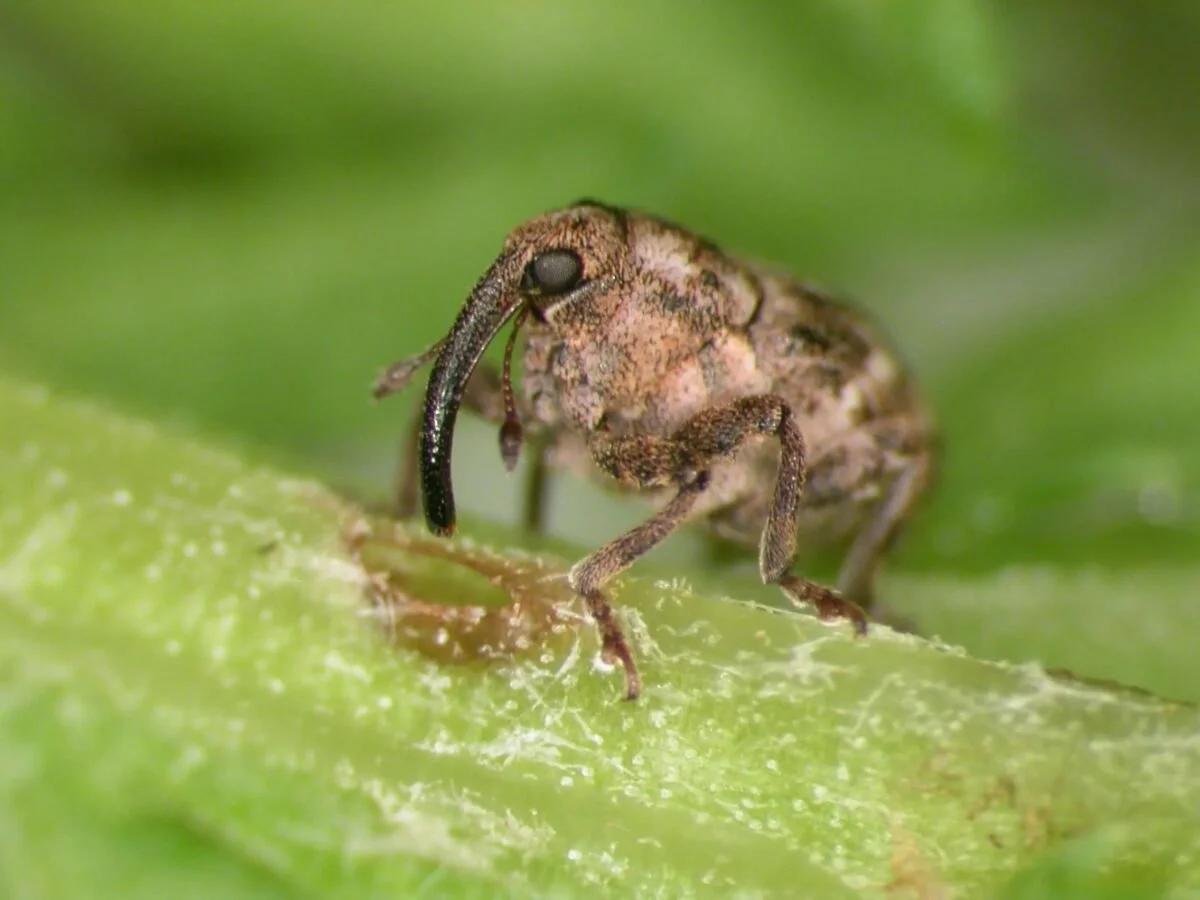
A small stem-mining weevil released at three sites in British Columbia this spring is the newest tool in a decades-long effort to control common tansy, an invasive plant that has been established in the Boundary for years.
Agriculture and Agri-Food Canada, working with the B.C. Ministry of Forests, released 1,200 adult Microplontus millefolii weevils at three B.C. sites in May. The Canadian Food Inspection Agency approved the insect in 2026 as the first biological-control agent in Canada specifically targeting common tansy, Tanacetum vulgare.
The CFIA received the release petition in 2025. CABI, which has been involved in the research program, announced the first Canadian releases on Aug. 18 and said additional releases are planned in British Columbia, Alberta and Saskatchewan this fall.
The three B.C. release sites were not identified in the announcement, and no public source reviewed by The Boundary Sentinel confirms whether any of them were in the Boundary.
Common tansy, however, is well established in the region.
The Boundary Invasive Species Society currently lists the plant under its “Control & Contain” category. The 2008 Boundary Invasive Plant Management Strategy described common tansy as widespread along roads around Anarchist Summit, where it had also moved onto private properties. Smaller infestations were documented along highway corridors throughout the Boundary, while a substantial infestation followed Myers Creek and the abandoned railway southwest of Midway.
At the time, the strategy stated that no biological-control agent was available for common tansy. Canada now has one.
A difficult plant to contain
Common tansy is a perennial plant native to Eurasia, recognizable in summer by clusters of round, yellow, button-like flowers above fern-like leaves.
It spreads through seed and an extensive root system, and root fragments can produce new plants. Once established, it can form dense stands along roadsides, stream banks, pastures and other disturbed areas.
The plant can displace native vegetation, reduce usable forage and is toxic to some livestock.
More than 10,000 hectares of common tansy have been recorded in British Columbia, according to Janine Brooke, an invasive-plant biocontrol specialist with the Ministry of Forests. Recorded infestations occur across different climate zones and at elevations ranging from about one metre to 1,600 metres.
Mechanical and chemical treatments can control infestations, but established populations can require repeated work. The 2008 Boundary strategy recommended treating sites outside the Anarchist containment area and controlling roadsides within it to limit further spread.
Biological control uses a different management approach. Scientists search an invasive plant’s native range for insects or other organisms that naturally attack it, then test potential candidates to determine whether they pose an acceptable risk to non-target species.
If an approved agent establishes successfully, it can form a self-sustaining population that continues attacking the invasive plant. The objective is generally to suppress the weed to manageable levels rather than eliminate it entirely.
Two decades of research
Research into biological control of common tansy in North America began in 2006.
Scientists examined several insects associated with the plant in Eurasia, but many potential agents were rejected because they were not considered sufficiently specific to common tansy. Testing of M. millefolii ran from 2010 to 2023.
The weevil spends part of its life inside tansy stems. Females lay eggs in the plant, and the larvae develop inside the stems, feeding on plant tissue and reducing the plant’s growth and reproductive capacity.
Host-specificity testing also found limited development on other plants. Three non-target test species occasionally supported egg laying and larval development, but researchers found very few larvae on those plants compared with common tansy.
The results were considered sufficient to seek regulatory approval, and the CFIA authorized the insect for release in 2026.
That approval followed a scientific review process intended to assess risks before a biological-control organism is introduced. The CFIA notes that biological-control agents can themselves pose environmental risks, including the possibility of becoming pests or carrying other pests, which is why proposed first releases undergo scientific review.
Once released, the work shifts from laboratory testing to field monitoring.
Researchers are now watching to see whether M. millefolii establishes successfully under different Canadian climatic conditions, how far it spreads and whether it reduces common tansy populations. Agriculture and Agri-Food Canada researchers have also said they hope suppression of the invasive plant will allow native vegetation to recover.
What it could mean for the Boundary
The B.C. Ministry of Forests intends to integrate M. millefolii into the province’s invasive-plant biocontrol program if the early releases are successful.
The Boundary already has experience with biological control. The Boundary Invasive Species Society lists several invasive plants for which biocontrol is used locally, including diffuse knapweed, St. John’s wort and hound’s tongue.
Common tansy remains listed under “Control & Contain.”
Whether the Boundary will be included in future releases of the new weevil remains unknown. The locations of the three May release sites have not been made public, and there has been no public announcement identifying the Boundary as a future release area.
For local land managers, the significance is the change in the available toolbox.
When the Boundary’s invasive-plant strategy documented common tansy infestations around Anarchist Summit and southwest of Midway in 2008, it noted that no biological-control agent existed for the plant. Eighteen years later, one has been approved and released in British Columbia, with further releases planned as researchers determine how well it establishes and how much effect it has on a weed that has already become difficult to remove from the landscape.








Nine new outdoor pickleball courts opened at Glenmore Recreation Park on Oct. 8, expanding public recreation facilities in north Kelowna as construction continues on other parts of the park.