B.C. judge narrows WestJet passenger-rights lawsuit over flight-delay reimbursements
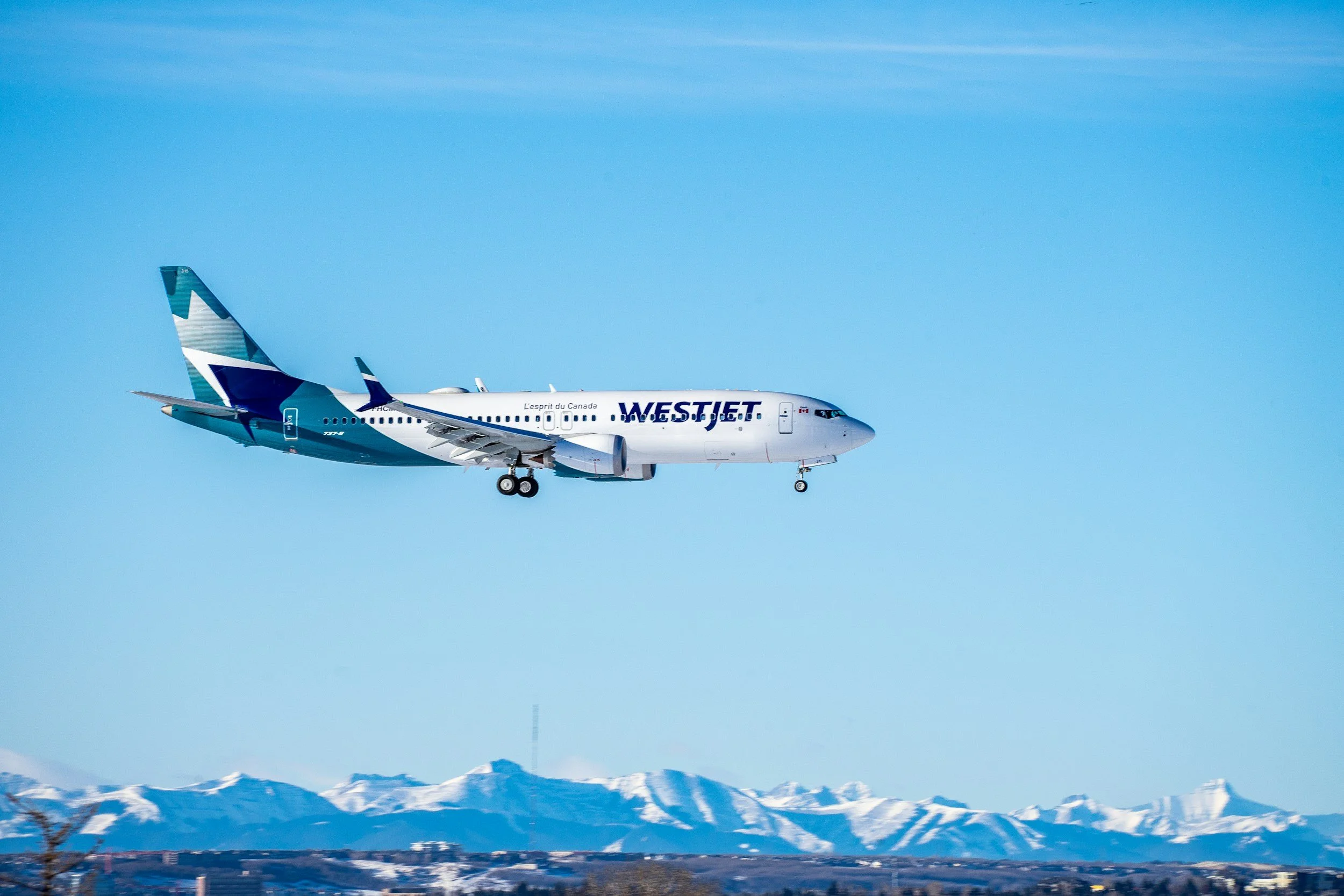
A WestJet Boeing 737-8 MAX. A B.C. Supreme Court judge has narrowed a consumer lawsuit challenging the airline’s handling of passenger reimbursement claims.
Photo: WestJet
A B.C. Supreme Court judge has narrowed a consumer lawsuit challenging WestJet’s handling of passenger expenses during flight disruptions, striking portions that sought to recover money for affected travellers while allowing the broader case against the airline to continue.
The Aug. 21 decision is the latest substantive ruling in a lawsuit brought by Air Passenger Rights, a non-profit organization that advocates for air travellers. The organization alleges WestJet engaged in deceptive practices through guidelines that limited or excluded reimbursement for some expenses incurred during flight delays.
Justice Scott Morishita ruled that Air Passenger Rights cannot use the province’s Business Practices and Consumer Protection Act to seek a restoration order on behalf of affected passengers in the way proposed in its amended lawsuit.
WestJet had asked the court to strike only the portions of the amended lawsuit related to that proposed restoration order and associated relief. It did not seek to strike Air Passenger Rights’ claims for declarations that WestJet contravened the consumer-protection law or for an injunction restraining the airline from doing so.
The decision does not determine whether WestJet’s reimbursement practices violated the law. That issue remains unresolved.
Lawsuit challenges reimbursement guidelines
The case stems from concerns raised by Air Passenger Rights over information WestJet provided to travellers seeking reimbursement for expenses caused by flight delays.
According to the court, WestJet’s website in 2024 told passengers that, in circumstances covered by its guidelines, hotel reimbursement would be limited to up to $150 CAD per night/per reservation in Canada, or $200 CAD for non-Canadian destinations.
Meal expenses were capped at $45 CAD per day/per guest.
The guidelines also said WestJet would not reimburse cellular roaming charges, lost wages or missed entertainment, sporting or excursion events, among other excluded expenses.
Air Passenger Rights alleges those limits were deceptive because the federal Air Passenger Protection Regulations and the Montreal Convention did not impose the same upper limits or exclusions. Those assertions form part of the organization’s case and have not been determined at trial.
The federal regulations currently require airlines, when the applicable provisions are triggered, to provide food and drink in reasonable quantities after a qualifying delay and to provide overnight accommodation that is reasonable in relation to the passenger’s location.
Air Passenger Rights is seeking declarations that WestJet violated B.C.’s consumer-protection legislation and an injunction. It also attempted to obtain an order requiring WestJet to restore money to passengers whose reimbursement claims were capped, partially paid or refused.
It was that last part of the case that WestJet challenged.
Judge strikes passenger repayment claims
Morishita found that Air Passenger Rights could bring a consumer-protection action even though it had no special interest or other interest under the Business Practices and Consumer Protection Act and was not itself affected by the consumer transactions at issue.
However, he concluded the legislation does not allow a non-interested party such as Air Passenger Rights to bring a restoration claim on behalf of other people.
The judge relied on earlier decisions from the B.C. Court of Appeal and Supreme Court of Canada dealing with section 172 of the Business Practices and Consumer Protection Act.
Morishita concluded that Air Passenger Rights’ claim for a restoration order for affected passengers had “no reasonable prospect of success.”
The judge reached a second conclusion that independently defeated the proposed remedy.
A restoration order under the legislation requires that a supplier acquired money or other property because of a contravention and that the beneficiary of the order was the source of the money or property.
Air Passenger Rights had instead pleaded that WestJet failed to pay passengers all of the reimbursement to which they were allegedly entitled.
Morishita found the pleadings did not allege that WestJet acquired money from those passengers. In substance, he concluded, Air Passenger Rights was seeking damages representing expenses that WestJet allegedly should have paid.
The court also rejected a proposed process under which an associate judge, registrar or special referee would assess passengers’ entitlement to money and determine the amounts owing. Morishita found those judicial officers did not have jurisdiction to decide entitlement to damages in the manner proposed.
The disputed portions of the amended notice of civil claim were struck.
Air Passenger Rights was, however, granted permission to amend most of the affected pleadings. Morishita found they were not so defective that amendment was impossible. The exception was the proposed claim for an inquiry, assessment or accounting by an associate judge, registrar or special referee.
WestJet was substantially successful on the application and is provisionally entitled to its costs in the cause. The parties may make written submissions if they seek a different costs order.
Separate fight over WestJet documents
Two companion rulings provide more detail about another dispute that developed during the same July 28-30 hearing.
Air Passenger Rights had sought production of WestJet documents containing redactions. Some redactions involved claims of privilege, while others were made on the basis that the information was not relevant.
WestJet proposed allowing Morishita to inspect the unredacted documents and hear submissions from the airline while Air Passenger Rights’ lawyer remained unable to see the material.
WestJet argued the redacted portions contained confidential and proprietary information and that disclosure to competitors or others could cause significant harm. Air Passenger Rights argued other protections could be used, including a confidentiality agreement or sealing order.
Morishita declined WestJet’s proposed approach.
He raised concerns about the open-court principle and about the fairness of receiving submissions from WestJet when the other side could not see the information being discussed. He also said the process could leave an incomplete record if either party later appealed.
WestJet relied on an affidavit describing the documents as containing internal information involving matters including verification procedures, fraud protection mechanisms, refunds and reaccommodation, travel-agent bookings, vacation packages, interline recovery and downgrades.
Morishita called the affidavit “cursory and conclusory” and found it did not provide enough information to justify the proposed private review. He said evidence supporting redactions of this nature should address individual documents and explain, as specifically as possible without disclosing the sensitive information itself, why releasing the material could cause harm.
By the following day, the parties had negotiated a consent order setting undertakings and rules governing the use of the unredacted documents, leaving only the question of costs for the court to decide.
Morishita found Air Passenger Rights had been substantially successful in that application and awarded it costs in any event of the cause.
He expressly found that WestJet had not engaged in misconduct. The enhanced costs order was based on his finding that the affidavit WestJet relied on “ought to have been much more thorough” and should have addressed the documents individually and explained why disclosure could cause harm.
Court hearing coincided with WestJet labour dispute
The three-day hearing took place July 28 to 30 as a separate labour dispute between WestJet and its cabin crew was escalating.
On July 30, CUPE Local 8125, representing WestJet flight attendants, announced it had issued a 72-hour strike notice. WestJet subsequently issued a 72-hour lockout notice.
The court rulings do not indicate any connection between the labour dispute and the passenger-reimbursement lawsuit.
A work stoppage began Aug. 2, affecting WestJet’s scheduled Boeing 737 and 787 operations. WestJet and CUPE announced a tentative agreement the following day, ending the stoppage and withdrawing the strike and lockout notices.
WestJet announced Aug. 24 that its cabin crew had ratified the new collective agreement.
The Aug. 21 ruling did not dispose of the entire action. Air Passenger Rights was given leave to amend most of the struck pleadings, while its claims for declaratory and injunctive relief were not challenged in this application.







Nine new outdoor pickleball courts opened at Glenmore Recreation Park on Oct. 8, expanding public recreation facilities in north Kelowna as construction continues on other parts of the park.