RDKB directs staff to seek review of FortisBC-BC Hydro electricity rate gap
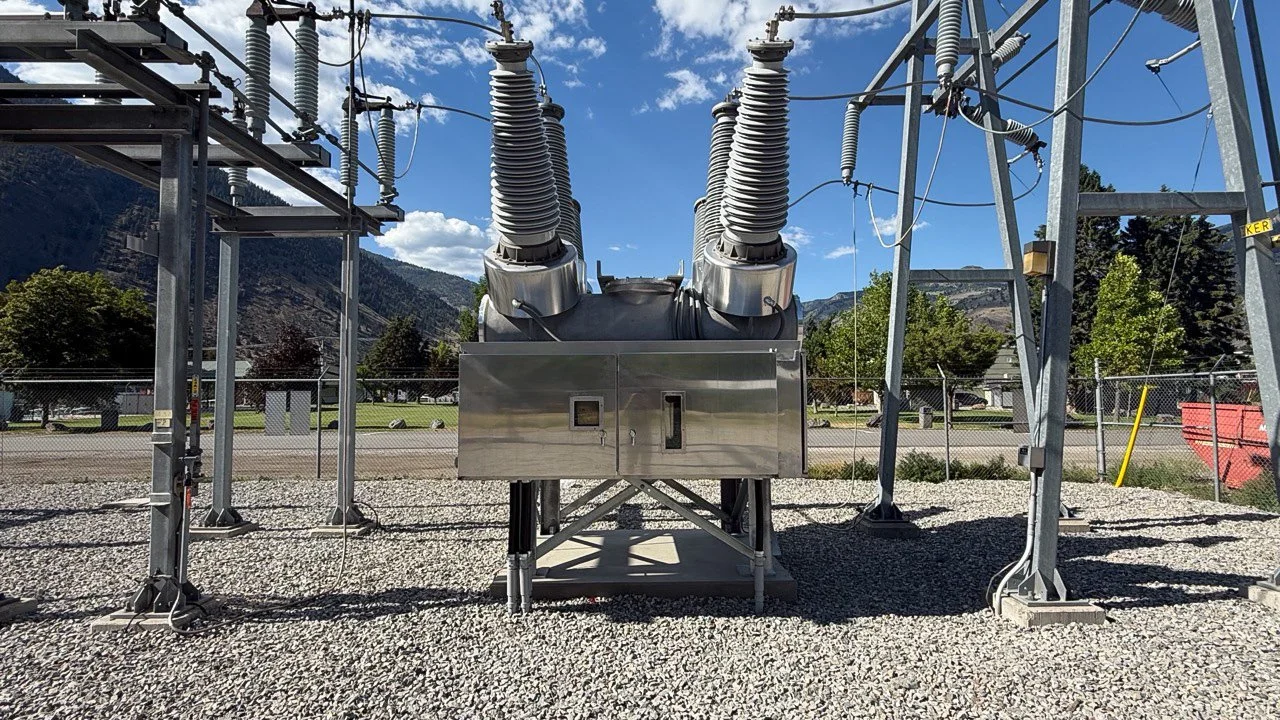
A new breaker at FortisBC’s Keremeos substation. The Regional District of Kootenay Boundary has directed staff to seek a provincial and regulatory review of the difference between FortisBC and BC Hydro residential electricity rates.
Photo: FortisBC
Residents served by FortisBC can pay substantially more for residential electricity than comparable BC Hydro customers, a disparity the Regional District of Kootenay Boundary wants the province and B.C.’s utility regulator to examine.
The RDKB board voted Aug. 26 to direct staff to write to the Province of British Columbia and the British Columbia Utilities Commission seeking a review of what the motion called the “lack of equity” in electricity billing between FortisBC and BC Hydro and its impact on rural customers.
The issue was brought to the board by Area A director Ali Grieve under an agenda item originally titled “Electricity Rate Equality.” In the adopted meeting minutes, the item is recorded as “Electricity Rate Inequality.”
Grieve presented information comparing residential rates charged by the two utilities and told the board that rural B.C. customers were being treated differently.
The board then carried Motion 313-26, directing staff to write to the province and the BCUC asking them to review the rate disparity. The minutes record the motion as carried without a recorded opposing vote.
The rate comparison circulated with the Aug. 26 agenda does not reflect the electricity rates currently in effect.
FortisBC’s residential electricity rate increased 3.63 per cent on Jan. 1. Residential customers now pay 15.503 cents per kilowatt-hour, along with a $49.58 customer charge based on a 60-day billing period.
BC Hydro’s tiered residential rate, effective April 1, is 11.87 cents per kilowatt-hour for the first 675 kWh on a monthly bill, with the threshold prorated according to the number of billing days. Consumption above that level is charged at 14.08 cents per kilowatt-hour. The basic charge is 23.44 cents per day.
FortisBC’s current energy charge is therefore higher than both tiers of BC Hydro’s residential rate.
FortisBC says its average residential electricity customer uses about 825 kWh per month. At twice that consumption over a 60-day period, or 1,650 kWh, FortisBC’s current energy and customer charges total about $305.
Using the same consumption, BC Hydro’s tiered energy and basic charges total about $217 over 60 days. That produces a difference of about $89, or 41 per cent, before taxes, BC Hydro’s current rate rider and other applicable adjustments.
Actual bills vary with consumption, billing periods and rate options.
The difference between FortisBC and BC Hydro residential rates has previously been raised before the BCUC.
During FortisBC’s 2025-to-2027 rate-setting proceeding, the Industrial Customers Group argued that the commission should investigate the difference between rates charged by FortisBC and BC Hydro.
FortisBC opposed a separate inquiry. In its January 2025 reply submission to the commission, the company said a FortisBC residential customer using 700 kWh per month was paying about 44 per cent more than an equivalent BC Hydro customer under the rates then in effect. At 1,000 kWh per month, FortisBC put the difference at about 30 per cent.
The company argued that comparisons between the utilities are affected by consumption levels and rate design, as well as differences in economies of scale, generation assets and provincial policy.
FortisBC Inc. is a regulated utility and subsidiary of Fortis Inc., while BC Hydro is a provincial Crown corporation. Both utilities have electricity rates regulated by the BCUC, but their costs and rate structures are not the same.
The BCUC approved FortisBC’s 2025-to-2027 rate-setting framework in March 2025, with annual reviews used to establish rates during the three-year period.
FortisBC has said increased costs to purchase electricity were a significant factor in its 2026 rate increase. The company operates four hydroelectric generating plants and also purchases electricity under long-term contracts and through wholesale markets.
The RDKB motion does not propose a particular method for reducing the difference between FortisBC and BC Hydro rates. It asks the province and BCUC to review the disparity and its impact on rural customers.
Electricity service also varies within the Kootenay Boundary. Grand Forks, for example, owns and operates its own electrical utility rather than receiving retail electricity service directly from FortisBC.
The RDKB’s Aug. 26 motion puts the regional district formally on record seeking further examination of why residents in different utility service areas can face significantly different residential electricity costs.







The Regional District of Kootenay Boundary has approved a 10-year operating agreement with the Christina Gateway Community Development Association for the Christina Lake Welcome Centre.