Boundary Transit avoids forecast tax jump, but funding pressure remains
RDKB held the transit tax requisition at $62,000 for 2026 while its public consultation raises longer-term choices involving taxes and service levels
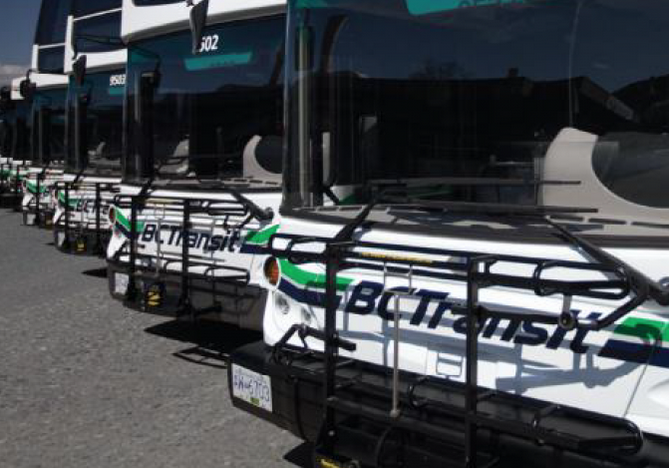
A row of BC Transit buses is shown in this file photo.
Photo credit: File photo/BC Transit
Residents in the Boundary Transit service area did not see the substantial increase in the transit tax requisition that had been forecast for 2026, but the Regional District of Kootenay Boundary continues to identify longer-term funding pressure as costs rise and its funding model changes.
The RDKB's 2025 financial plan had projected the Boundary Transit tax requisition would increase from $62,000 in 2025 to $124,639 this year. The approved 2026-2030 financial plan instead holds the requisition at $62,000 this year and keeps it at that level throughout the five-year forecast.
Boundary Transit entered 2026 with a $45,101 accumulated surplus. RDKB staff attributed that surplus to lower BC Transit operating costs in 2024 and 2025, savings on 2025 contract costs, and fare and Interior Health revenues that came in above budget.
The current budget also includes $51,534 in annual grant funding in addition to the tax requisition. RDKB staff said approximately $52,000 in grant funding above the requisition is needed each year to maintain the existing service.
Interior Health remains part of the current financial picture. The RDKB's five-year plan budgets $41,010 annually in Interior Health Health Connections revenue through 2030.
At the same time, the regional district continues to warn residents that changes are coming to the transit funding model.
On its Boundary Transit public engagement page, the RDKB says Interior Health funding currently earmarked for transit is to be redirected to other health-specific initiatives, which the district says would leave local residents responsible for a larger share of the cost.
The district has not identified an effective date for that change on the engagement page, and the Interior Health contribution remains included in the current five-year financial plan.
The RDKB has already asked residents to consider what should happen if more local funding is required.
Four options were presented during the consultation: keeping taxes at their current level and reducing service; increasing taxes to maintain current service; lowering taxes and reducing or eliminating service; or raising taxes further to improve service.
The district said public feedback would help determine its next steps and could eventually lead to a referendum. The online poll and discussion have since closed.
Boundary Transit currently serves Grand Forks, Greenwood, Midway, Electoral Area D/Rural Grand Forks and Electoral Area E/West Boundary. The RDKB has also identified Electoral Area C/Christina Lake as a possible future service area.
The service has little room to raise additional money under its existing taxation authority. The annual tax requisition is capped at $62,500 under RDKB Bylaw 1834, while this year's requisition is $62,000.
The current financial plan uses reserves to help absorb increasing contract costs over the five-year period.
Boundary Transit is projected to finish 2026 with about $60,655 in reserves. That balance is forecast to decline to $23,644 by the end of 2030 if current assumptions hold.
Contracted service costs are budgeted at $151,558 this year and are projected to reach $176,166 by 2030.
For 2026, the budget includes the $62,000 tax requisition, annual grant funding, Interior Health revenue and the accumulated surplus carried into the year.
The longer-term funding question remains unresolved. The district's consultation presents residents with choices involving taxes, service levels or both, while the current financial plan shows the system continuing to rely on funding beyond the existing tax requisition.



Twenty-one years after Tamara Lynn Chipman was last seen on a northern B.C. highway, RCMP investigators are again asking anyone who knows what happened to her to come forward.