Wilson, Russell campaign for Boundary-Similkameen rematch
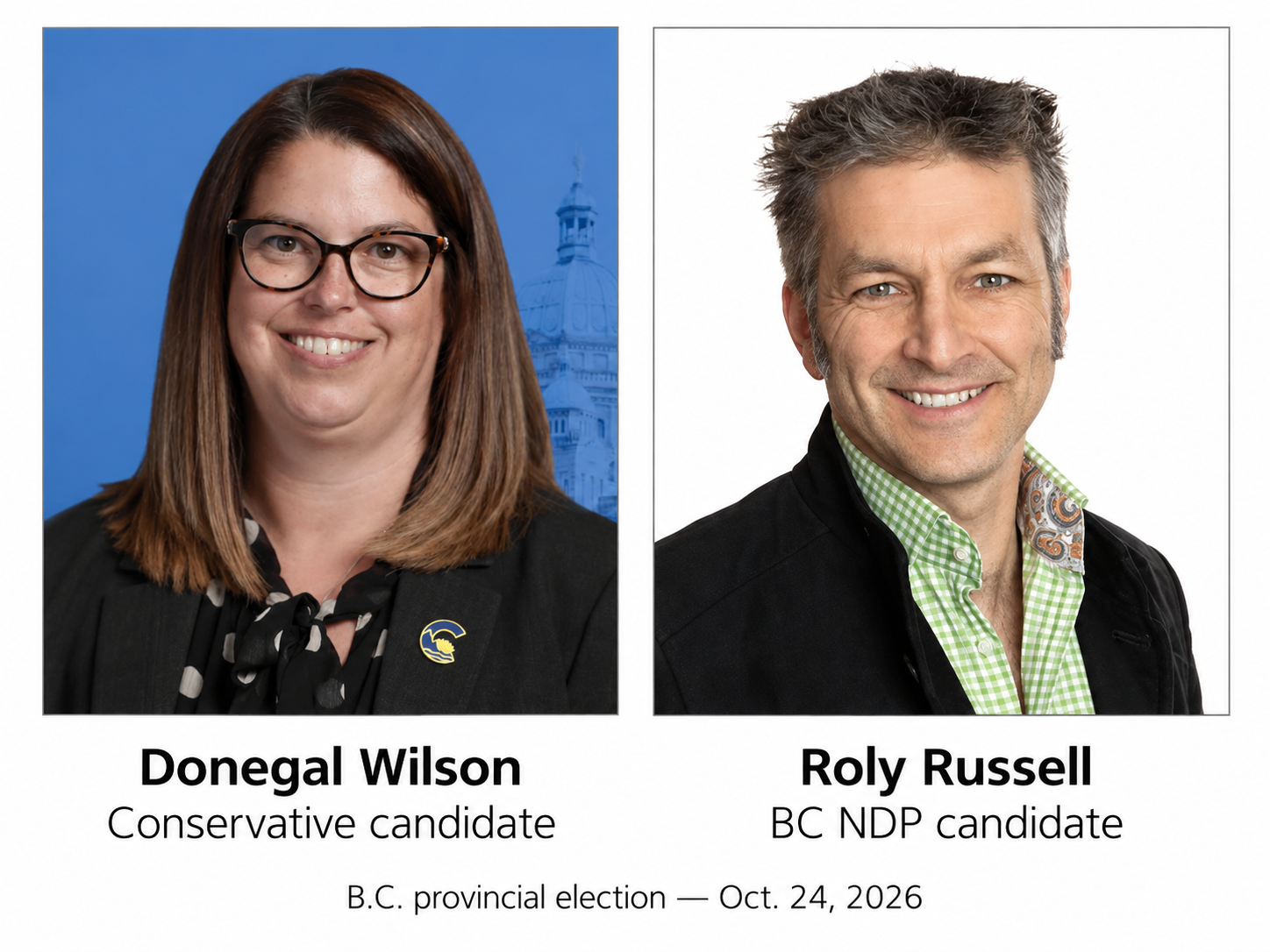
KEREMEOS — Just under two years after Donegal Wilson took Boundary-Similkameen from Roly Russell, the Conservative incumbent and former NDP MLA are back on the campaign trail in a riding where health care, forestry, water and the rural economy are already emerging as central issues.
Both spent Saturday at the Similkameen Sizzle in Keremeos, posting separately from the annual hot-pepper festival at Memorial Park. Wilson talked about agriculture and the community event, while Russell said he had spent the day travelling through Oliver, Osoyoos and Keremeos and talking with residents about forestry permitting, local decision-making and keeping more economic activity in rural communities.
The appearances came days after both made clear they intend to run in the Oct. 24 provincial election. Conservative Party of B.C. lists Wilson as its candidate for Boundary-Similkameen, while Russell announced Sept. 24 that he is running with the BC NDP.
Neither name appeared on Elections BC’s list of accepted nominations as of Sept. 27. Elections BC says that running list includes only candidates whose completed nomination papers have been accepted and does not include everyone who has publicly declared. Nominations remain open until 1 p.m. Oct. 3.
Rematch after two years
Wilson and Russell last faced each other in 2024, when Wilson won 11,935 votes, or 48.39 per cent, to Russell’s 10,497, or 42.56 per cent. Green candidate Kevin Eastwood received 1,454 votes and independent Sean Taylor received 779.
Russell’s raw vote barely moved from the previous election. When he won Boundary-Similkameen in 2020, he received 10,500 votes — only three more than he received when he lost four years later. His share of the vote fell from 49.85 per cent to 42.56 per cent as the number of valid ballots cast increased from 21,063 in 2020 to 24,665 in 2024.
Wilson’s record in opposition
Wilson was elected to the legislature for the first time in October 2024. Born in Summerland and raised on a cattle ranch in the Otter Valley near Tulameen, she graduated from Princeton Secondary before working in administration, business and non-profit management. She and her husband founded Direct Performance, a small-engine business in Keremeos, and Wilson became executive director of the BC Snowmobile Federation in 2012.
In Victoria, much of Wilson’s constituency-focused work has centred on rural health care, drinking-water systems and the resource economy.
She has pressed the government over access to emergency care in Princeton. In February, Wilson questioned the health minister after Princeton hospital diverted emergency patients for an evening. Wilson described the incident in the legislature as a closure, while the minister described it as a diversion and pointed to the community’s overnight virtual emergency-care model.
Water has become another recurring file. Wilson questioned the government in 2025 about the Sage Mesa water system near Penticton, which has been managed through the provincial comptroller of water rights since the province took control of the privately owned utility in 1990. She returned to the issue this year as residents faced mounting infrastructure costs and told the legislature in March that combined water costs for some households could exceed $12,000 a year.
In May, Wilson moved an amendment to a legislative motion on private wastewater utility rates seeking to extend the discussion to private water utilities as well.
Forestry has also featured prominently in her work. In October 2025, Wilson raised the Grand Forks Interfor mill in question period amid a period of curtailed operations, describing the mill at the time as closed indefinitely and arguing that fibre shortages and provincial forest policy were threatening workers, businesses and municipal finances. Interfor currently lists Grand Forks among its operating divisions.
Wilson also served on the legislature’s Select Standing Committee on Finance and Government Services and was elected deputy chair in January. During committee proceedings, she described a background that included bookkeeping, accounting work, non-profit management and responsibility for multi-million-dollar budgets.
A departure and return to the Conservatives
Her legislative record is now part of her case for another term, but her movement between political groups this month has introduced a new issue into the campaign.
Wilson was elected as a Conservative in 2024 but left the caucus after losing confidence in then-leader Kerry-Lynne Findlay.
In a Sept. 14 statement announcing that she would join six other MLAs forming a new provincial party, Wilson said she had left the Conservative caucus because she could no longer support Findlay’s leadership. She said her conservative principles had not changed and that she had initially intended to remain outside another party.
Wilson said she changed course after meeting with the independent MLAs involved in forming the new group and seeing what she described as their willingness to have difficult conversations about what the party should stand for and how it should operate.
At the time, Wilson described the project as a practical and fiscally responsible political alternative to the NDP. Her language about the Conservatives was pointed: “I am not interested in rebuilding an old, failed party,” she said.
Less than two weeks later, Wilson had returned to the Conservatives under new leader Lorne Doerkson and was again campaigning under the party banner.
Wilson has acknowledged publicly that the changes have raised questions. In a recent campaign post, she said that under Doerkson the party was “coming together” and focusing on the election. She said she would answer questions about the recent changes and described herself as the Conservative candidate “for the long haul.”
Her return leaves a question likely to follow her through the campaign: what changed between her decision to leave the Conservatives, join a new political project and then return to the party shortly afterward, and which of the concerns that prompted her departure have now been resolved.
Russell runs on his record
Russell enters the race with four years of provincial experience and a longer record in local government.
Born and raised in rural Grand Forks, he has a PhD in ecology and worked on biodiversity, sustainability and decision-making before entering provincial politics. He operated an organic farm, helped develop local food strategies, co-founded an agricultural society and served with the Certified Organic Association of B.C.
Russell represented Rural Grand Forks on the Regional District of Kootenay Boundary board and served as board chair. When flooding devastated Grand Forks in 2018, provincial records credit him with helping coordinate the local response and establish a community-led disaster-recovery model. The following year, as B.C. consulted on changes to its emergency-management framework, Russell drew on the Grand Forks experience in arguing for better recovery tools for communities.
Russell won Boundary-Similkameen for the NDP in 2020 and was appointed parliamentary secretary for rural development shortly afterward. He remained in a rural-development role under both John Horgan and David Eby.
His 2026 campaign is leaning heavily on that record. In his Sept. 24 announcement, Russell pointed to changes to emergency management and disaster recovery, health-worker incentives in the South Okanagan and economic-recovery funding in the Boundary following the Vaagen mill closure.
The underlying programs are documented in provincial and local-government records, although Russell’s personal role in securing them remains a campaign claim that requires attribution.
In 2024, B.C. expanded its Provincial Rural Retention Incentive to health-care workers in Oliver, Osoyoos and Okanagan Falls. About 200 employees were expected to qualify, with most eligible Oliver workers based at South Okanagan General Hospital and incentives worth up to $8,000 a year. Russell was quoted in the provincial announcement thanking those who had pushed for the expansion.
The province also provided $165,000 to the Village of Midway for Boundary-region economic-diversification work following the economic disruption caused by the Vaagen mill closure. Russell’s campaign says he helped bring that funding to the region.
Russell has also addressed what he sees as a weakness from his previous term. In his campaign announcement, he said he spent more time doing the work than telling people about it and intends during this campaign to make a clearer case for what he accomplished while in office.
His early campaign message combines resource development with environmental stewardship and greater local control. Russell says he wants more jobs generated from forestry, agriculture and mining, fewer permitting obstacles and more decisions made closer to the communities affected by them. He has tied those economic goals to health-care staffing, schools and other rural services.
Wilson is drawing on many of the same local pressures but offering a different argument about provincial policy.
In a campaign post Sunday, she backed a Conservative pledge not to increase taxes during a term in government and criticized Budget 2026 for raising the tax rate on the first personal-income bracket from 5.06 per cent to 5.60 per cent.
The rate increase is contained in the provincial budget. The government also increased the B.C. tax reduction credit and says more than 40 per cent of taxpayers will receive a net income-tax saving after the changes, while the average taxpayer will pay an additional $76 in provincial income tax in 2026.
Wilson has also criticized the government’s planned expansion of the provincial sales tax to professional services and its decision this month to pause the measure. The province announced Sept. 18 that it would delay the planned Oct. 1 expansion, citing international trade disruptions and economic uncertainty. Wilson and the Conservatives argue the reversal followed opposition to the measure and came immediately before the election.
Health, forestry and affordability emerge as campaign issues
The two campaigns are already converging on several pressures facing Boundary-Similkameen: rural health care, forestry jobs and fibre supply, drinking-water infrastructure, agriculture, affordability and the future of resource-dependent communities.
Wilson is emphasizing taxation, provincial spending and government accountability. Russell is emphasizing rural economic development, resource-sector permitting, government investment in services and greater local decision-making.
Their records will also be part of the campaign. Wilson has nearly two years in opposition for voters to examine, along with her departure from the Conservatives, decision to join a new political project and subsequent return under a new leader. Russell has four years as a government MLA and parliamentary secretary to defend, as well as a 2024 defeat in which his raw vote total remained almost unchanged from the election he won four years earlier.
Both candidates were back in Keremeos on Saturday for the Similkameen Sizzle, though their posts emphasized different parts of the day. Wilson highlighted agriculture and community participation. Russell used his post to discuss forestry permitting, local decision-making and keeping more economic value in rural communities.
What happens next
The campaign will return to Keremeos this week. The Similkameen Country Development Association has scheduled a non-partisan election forum for Thursday, Oct. 1, from 6 to 7:30 p.m. at the Keremeos Legion. The association says all candidates will be invited and given an equal opportunity to participate.
Advance voting runs Oct. 16 to 21, with Final Voting Day on Saturday, Oct. 24. Candidate nominations close at 1 p.m. Oct. 3, meaning the full Boundary-Similkameen ballot has not yet been finalized.
For the second provincial election in a row, Wilson and Russell are asking Boundary-Similkameen voters for the seat. Wilson is campaigning on nearly two years as the riding’s representative while facing questions about a month in which she left the Conservatives, committed to a new political project and then returned after a leadership change. Russell is asking voters to look again at his record from four years in government, including accomplishments he says he did not do enough to communicate before losing the seat in 2024.
The Oct. 1 forum will give voters one of their first opportunities of the campaign to hear how those records translate into what each candidate says should happen next.





The Grand Forks Border Bruins came within a goal of their first British Columbia Hockey Conference victory Saturday, falling 5-4 to the Osoyoos Coyotes at Jack Goddard Memorial Arena.